Continuing with the theme of film festival intrigues that I missed, is I, Anna, a noir thriller starring Charlotte Rampling and Gabriel Byrne. It's directed by Rampling's son, Barnaby Southcombe (great name!), an accomplished television director who adapted the story from Elsa Lewin's novel of the same name. I'm not as familiar with Rampling's career as I probably should be, but she is quite recognizable. And Gabriel Byrne is always great to watch. In this film, they both bring a lonely world-weariness, perfect for a film noir. Their faces are so complex, so many emotions tied up in subtle movements: mystery, sadness, repressed aggression and sexuality, a dark past -- all hallmarks of the classic noir characters. Byrne plays a detective investigating a murder with possible links to Rampling's femme fatale. Like so many detectives before him, he seems to fall for her, getting closer than he should -- surely it will obscure his judgment and complicate the investigation. And is she genuine in her interest of him, or is it all just a facade? Looking forward to see this neo-noir too.

LE VIDEO SHELF: a love letter to all things film
Showing posts with label Film Noir. Show all posts
Showing posts with label Film Noir. Show all posts
23.5.13

6.6.12
HOUSE OF GAMES (1987)

Written and directed by David Mamet.
If you are familiar with Mamet, you know that he is known for his incredible smart and intricate plots, as well as his colourful dialogue, and in HOUSE OF GAMES, his debut feature film, he shines. I just watched this and it was brilliant! I'm trying to remember where I heard about it, but I'm glad I put it on my "to-watch" list when I did because this is truly a hidden gem of a film. It is a sharp and witty neo-noir, steeped in expressive lighting, paranoia, twists and turns, and dynamic characters. It is a world where it is impossible to know who to trust, and even the protagonist's motives are dubious.
 |
| Straight-edged Dr. Margaret Ford (Lindsay Crouse) |
 |
| A younger Joe Montegna is a smooth-as-ice cardsharp. |
What follows is a twisty and turny mystery story, where it is impossible to say where reality ends and a con begins. Margaret becomes involved in a confidence scheme, but who is really being fleeced? Characters come and go, but who knows whether they truly are strangers, or just accomplices in on the take? It is also a intriguing look into the world of the confidence man. This is not a new or original topic to be explored in film, but under Mamet's expert scripting, it becomes a fascinating film to watch. Mamet is primarily known for his theater, but his is an art that translates effectively to film. At times it feels like it is theater, but it doesn't matter, his dialogue is immersing. His actors deliver the lines theatrically, and I mean this not as a criticism, but rather an observation. Like many great films, where the actors speak in ways that people likely wouldn't normally -- for example old film noirs like THE BIG SLEEP or THE MALTESE FALCON -- the dialogue is so liquid and rich, it doesn't matter.
For anyone interested in Mamet, film noir, mysteries, stories about confidence men, or poker, take a look at this film. Criterion recently put out an excellent DVD of it. It is a fascinating film, and one that will leave you questioning things up to -- and beyond -- the last frame.
Trailer:
19.12.11
BRUTE FORCE (1947)
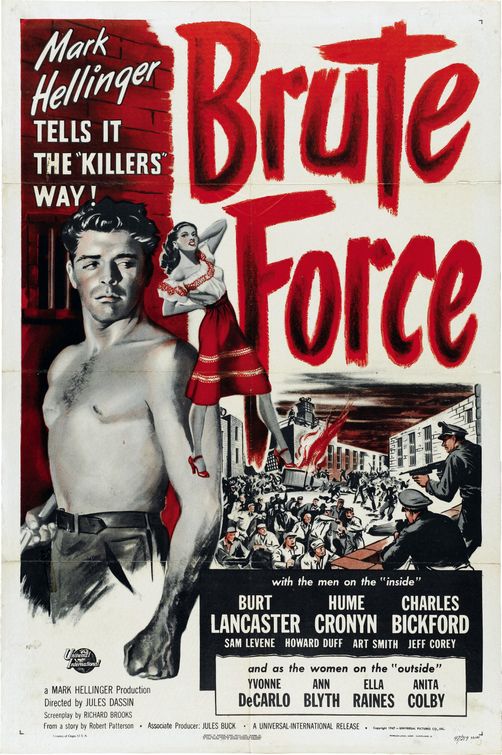
It is a nice coincidence that I watched Jules Dassin's BRUTE FORCE today seeing as how yesterday would have been his 100th birthday, had he not died in March 2008. Who is Jules Dassin you may ask? Despite having a distinctly European sounding name, he was a talented American born filmmaker who made several very successful crime movies in the US in the 1940s--THE NAKED CITY, BRUTE FORCE, and THIEVES' HIGHWAY (I've yet to see this one)--before he was blacklisted in 1950. He struggled to find work, and even after he went to Europe he had difficulty getting films made as American distributors threatened to boycott releasing any of his work. His next film wasn't until 1955's excellent and influential (and French) heist film RIFIFI, said to have inspired modern films such as OCEANS 11. It also informed his 1964 film TOPKAPI, which, when I caught the last half it on TV recently I noticed must definitely have influenced Brian de Palma in filming the CIA heist sequence in MISSION: IMPOSSIBLE when Tom Cruise enters via the ceiling.
 |
| Director Jules Dassin |
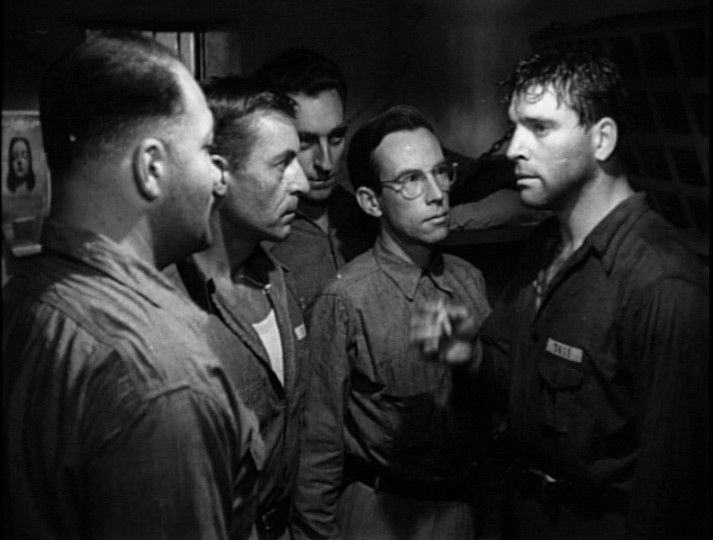 |
| Burt Lancaster as Collins (far right), and his cellmates. |
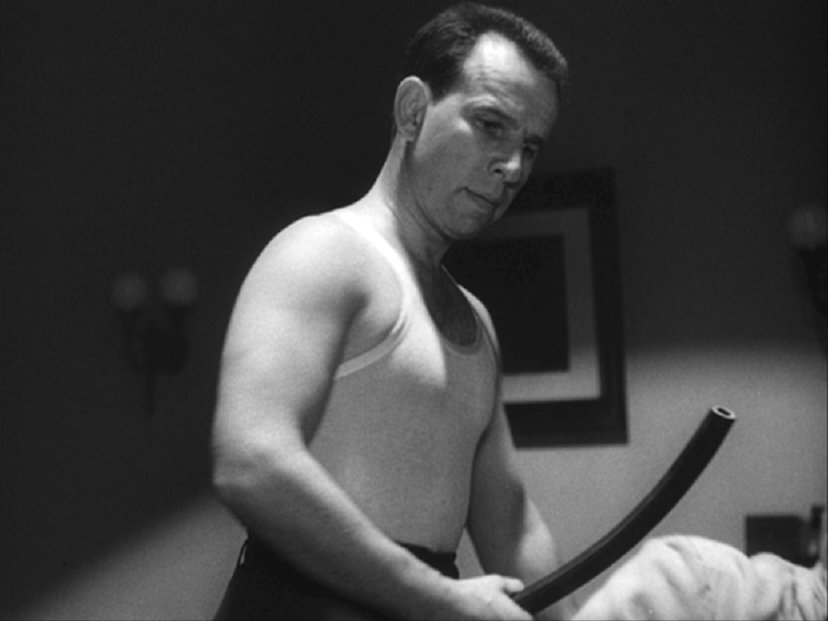 |
| Hume Cronyn as Capt. Munsey. |
It is also interesting watching an older prison drama. Prison life has been rather white-washed in two senses, one, in a literal sense, most of the prisoners are white males (contrary to the massive number of African-Americans in prison in actuality), but also, two, this prison seems kind of cleaned up and humane. Life seems to be relatively liveable with movies screened and plenty of different job details for inmates. Five or six men crammed into a prison cell seem to be tolerable, and downright friendly with each other. There are no drugs and hardly any violence between inmates--except the "accidental" death of one informant (a person who betrays his brothers). So yeah, life seems fairly liveable here--that is until you're summoned to Munsey's office and he draws the blinds.
BRUTE FORCE is a fantastic film, a riveting drama and prison break story that truly culminates in an explosive climax. In a way, it isn't a huge stretch to see why it may have come to the attention of the HUAAC and gotten Dassin blacklisted. It is the story of one courageous young man, rising up with his oppressed brothers to overthrow the leader for the greater good; where the one sacrifices himself for the many. But despite your ideological leanings, it is a really well made film, with excellent performances by Lancaster and Cronyn, as well as Charles Bickford as Gallagher, the prison's newspaper editor who has seen it all, and Art Smith as Dr. Walters, as the prison's doctor, and sometimes moral conscience. Go find this at your local video store or library, Criterion has an excellent DVD of it out!
Trailer:
BRUTE FORCE is a fantastic film, a riveting drama and prison break story that truly culminates in an explosive climax. In a way, it isn't a huge stretch to see why it may have come to the attention of the HUAAC and gotten Dassin blacklisted. It is the story of one courageous young man, rising up with his oppressed brothers to overthrow the leader for the greater good; where the one sacrifices himself for the many. But despite your ideological leanings, it is a really well made film, with excellent performances by Lancaster and Cronyn, as well as Charles Bickford as Gallagher, the prison's newspaper editor who has seen it all, and Art Smith as Dr. Walters, as the prison's doctor, and sometimes moral conscience. Go find this at your local video store or library, Criterion has an excellent DVD of it out!
Trailer:
15.9.11
HIGH AND LOW (1963)

Part of the reason I started this blog is because I know that there are scores of wonderful movies out there in the depths of video stores, libraries, and the internet, and all they need is someone to champion them. Now I won't for a second pretend to be the only person or in the least bit unique for praising a film like Akira Kurosawa's HIGH AND LOW. In fact that are many, hundreds, thousands no doubt, of people who are more versed in Japanese films and have academic or more erudite opinions than myself. That being said, I love discovering older films that certainly deserve to be re-surfaced from time to time to the masses, before they are inevitably plunged back down into the annals of film history. And this video blog is also for the person who goes into the video store, scans the shelves, and proclaims "there are no good movies out right now!" to which I respond, there are thousands of fantastic movies out there, in fact, every single movie that has ever been out is out there, you just have to look past the new releases!
Which brings me to HIGH AND LOW. As I said, I won't claim to be The One who brings this to the masses, I just came across it and its praises on the Criterion Collection's website while browsing the film noir genre, and knowing what a tremendous filmmaker Akira Kurosawa is, as well as previous enjoying one of his other contemporarily set thrillers, I had a feeling I would enjoy this as well. The fact that it was yet another collaboration (I previously spoke fondly of them working together on THE BAD SLEEP WELL) with my now favorite Japanese actor, Toshiro Mifune, did not hurt either.

Toshiro Mifune
HIGH AND LOW tells the story of a kidnapping. Mifune stars as Kingo Gondo, a wealthy executive who is made responsible when a child is kidnapped. Gondo must determine whether or not to pay the astronomical ransom and face financial ruin, or to save the son of another man. What follows is the plotting of the exchange, the investigation, and the apprehension of the perpetrator. It is an incredibly well calculated and paced film. Kurosawa patiently plots the film, letting scenes take as long as they need to. It is almost as if his characters are real, fully rounded people who need time to process their decisions. It is really quite fantastic. Whereas in a more typical contemporary film, the executive might immediately decide to sacrifice his own wealth to save a child, I mean, of course! That is the only choice! But realistically a person faced with a decision of that magnitude, must surely weigh his own ruin, the futile end of decades of hard work, from beginning as a mere factory worker and his ascension to executive, to the level of comfort and lifestyle he has achieved. Kurosawa allows Gondo to come to his own conclusion in his own time.

Legendary composition.
Kurosawa's films are also known for their incredible shot composition. He is so conscious of his 2.35:1 wide screen frame (in "TOHOSCOPE!") and his characters are delicately placed like chess pieces to convey their relations towards each other, or their social or situational standing. Each character occupies his own space. Almost any frame of this film could be printed and hung on the wall as a work of art; they are so full of intent and emotion. It is positively inspiring.

And the content is compelling as well. In one sense, it is a rigid police procedural. We see the guts of the investigation: meetings, briefings, and the going-over of many details that clearly explain the conclusions the police arrive at. We also see them out in the field, scouting different locations or questioning witnesses they consider to be pieces of the puzzle in the apprehension of the criminals. If you are a fan of TV's Law and Order, this will look familiar! In another sense, HIGH AND LOW is an examination of the class disparity in post-war Japan, which the title is a reference to (in Japanese, it is translated directed as HEAVEN AND HELL). Gondo is a wealthy industrialist, whose house is perched atop a hill, overlooking the slums and factories of the city. We see both worlds; the high-rolling scotch whisky drinking executives in their mansions, and we see the drug-infested, putrid slums of the less fortunate.

Creeper in the bushes!
The last thing to mention, is that despite it's nearly 50-year age, this remains a riveting and at times downright exciting film (SEE: the bullet train sequence!). Now some, (not you, of course!) but some people, roll their eyes and turn away when they see either "black and white" or "foreign" or "1963" or "subtitles" and think it will be boring and I mean who wants to read a movie... but honestly, you will be surprised! Yes it is long, yes it is foreign, but it holds up tremendously. And that is a testament to Kurosawa's skill as a filmmaker, his eye for detail, and his penchant for storytelling. This is a story and a film that feels as fresh--fresher, even, if you consider it's age--to any number of police or crime thrillers of today. Have a look at HIGH AND LOW, and if you can try and see it on Criterion's new Blu-ray or DVD!
16.6.11
THE BAD SLEEP WELL (1960)

The other night I watched Akira Kurosawa's THE BAD SLEEP WELL and it was terrific! It is a fairly epic tale with Shakespearean familial conflicts combined with post-war corporate corruption and staged within a framework of film noir. So, very interesting! The story follows a young man (Toshiro Mifune) who is avenging his father who was either murdered or compelled to commit suicide by his employers amid some intense multi-billion yen construction corruption. At about 150 minutes it is not a fast paced film, but it is intricately planned and directed by Kurosawa, an absolute master of Japanese cinema. You might recognize the name Toshiro Mifune, as he and Kurosawa had worked together a number of times through the 50s and 60s. I remember Mifune most from Kurosawa's samurai epics SANJURO, YOJIMBO, THE SEVEN SAMURAI, and RASHOMON where he often plays a grizzled ronin, a masterless samurai, who wanders feudal-Japan as a sword for hire. He's often bearded and has long hair in a top-knot, so it was quite a change to see him in Clark Kent-mode in THE BAD SLEEP WELL where he dons a suit, glasses, and nicely combed hair. Anyways, Mifune is fantastic in this. It is not a film for all, but if you are interested in Mifune or Kurosawa, this is a wonderful example of their synergy. Mifune's characterization is so enjoyable to watch as he grapples with his own anger. Kurosawa, meanwhile, carefully composes his shots in his great tableau style and keeps the ranging storyline moving by infusing lots of noir stylings. If any of this interests you, you should check it out! Criterion has an excellent DVD out with a great crisp black and white video transfer. It looks great.
Mifune in THE BAD SLEEP WELL:
 Mifune in SANJURO:
26.8.10
Body Heat (1981)

Another great film to add to the list of excellent debut features is Lawrence Kasdan's Body Heat. It's a moody, sexy, thrilling neo-noir film that perfectly balances it's noir roots with a newfound and more overt sexuality, displayed candidly by William Hurt and Kathleen Turner.

Hurt and Turner.
The story is classic noir (and certainly inspired by Double Indemnity). A small-time lawyer in a sleepy Florida beach community begins an affair with a married woman who doesn't much like her dull but wealthy husband. Their relationship develops to the point that they realize that the husband must disappear permanently for them to get what they want--unlimited each other, as well as the contents of the will!--so they contrive a plan to eliminate the husband and do just that. Things get sticky as everything begins to unravel and people begin to doubt their trust in one another. It's great! A moustachio'd William Hurt and a sultry Kathleen Turner star as the two lovers, and there are a few other familiar faces, including Ted Dansen as Hurt's DA buddy, and Mickey Rourke as an ex-con. (On a side-note, Kathleen Turner used to be such a babe! In the early 1980s she was the go-to sexpot actress, but now, as my friend Jane so succinctly put it, she has "morphed into a fridge," as her recent appearances as Sue Collini on Showtime's brilliant David Duchovny vehicle Californication is any indication.)

Kathleen Turner as Matty Walker.
This 1981 film perfectly captures an updated version of the noir sensibilities, with lots of suggestive dialogue, classic noir archetypes, great metaphors, and mystery right up to the ending. A great element to the whole thing is the fact that the town is going through a major heat wave which leads to some great dialogue, atmosphere, and lots of very sweaty people. Hot temperature really lends itself to noir stories, as it aids to create a mood of even further discomfort and claustrophobia, not to mention it invokes a hellish environment for our sinners to play out their lives. The heat and humidity are present to an almost nightmarish degree as all our characters quickly throw back drinks and then seemingly sweat them out instantly.

William Hurt as Ned Racine.
One obvious difference between this and the noirs of the original cycle is the overt sexual nature. This film is largely driven by sex and sensuality (the title is quite apt!) and it makes no bones about it. Due to the production code of the 1940s and 50s, studios were barred from having nudity or sex, and therefore had to find more creative ways to convey sensuality, and that came out through very suggestive and innuendo laced dialogue. Body Heat combines this style of writing, but in the more liberated 1980s America it also uses a fair amount of the naked bodies of Kathleen Turner and William Hurt.

Mickey Rourke as Teddy Lewis.
Definitely watch this film if you are interested in the noir genre, and it is highly recommended if you like a neo-noir take on things, it's a great example of a movie that embraces the past films to which it owes to much, but also adds new and more contemporary ideas to the genre. This film is great!

Hurt and Danson, in swelteringly soft focus.
The trailer: simple, suggestive, effective.
25.7.10
Kiss Kiss Bang Bang (2005)

This is a gem of a film. Written and directed by Shane Black (who wrote all the Lethal Weapon movies), and starring Robert Downey Jr., Val Kilmer, and Michelle Monaghan, it is a hilarious "fusion of buddy movie and hardboiled noir" (-DVD case), that charmed me with its unpredictable twists and turns, and it's clever dialogue ("She opened the door and had nothing on but the radio."). It has got to be one of the best neo-noir films out there, thanks to the dark yet colourful atmospheric cinematography of Michael Barrett, and the creative direction by Black. But most of the praise should be rightly accorded to Downey and Kilmer, both of whose performances are hilarious, touching, and quite dynamic. Downey plays petty criminal Harry Lockhart, who, in New York City, literally on the run from the police, storms unknowingly into an audition room, where he delivers what the producers read as a stunning grief-stricken performance. Lockhart is then sent to LA for screen tests where he is teamed up with Perry (Kilmer), a gay local private detective who also serves as a consultant for studios and actors. Harry and Gay Perry go out on a job, and soon get wrapped up in a mystery fit for a Raymond Chandler novel, with twists and turns, several bodies, and a severed ring finger. Everyone seems to have at least one gun and bodies appear around seemingly every corner as the plot unravels itself.


Robert Downey Jr. as Harry Lockhart.

Val Kilmer as Gay Perry.
Shane Black impressively keeps it all on track and coherent, and also draws some fantastic performances from his leads. Robert Downey Jr. plays Harry perfectly, taking a page right out of the pulp novels of the 1940s, playing his thief/actor/P.I. as a wounded man (both emotionally and physically) with tenderness and wit. Val Kilmer is also brilliant in what is most likely one of the best roles of his career. Kilmer could have taken this role way over the top, but he plays it perfectly; he is so subtly gay and quite sly, and he's also tough and doesn't take any crap from anyone. And when these two are put together their back and forth banter and altercations hint at a genuine growing friendship. They also just plain look like they had fun making this film. Downey does double-duty by also taking on the role of our very self-aware narrator, who directly talks to the audience, making references to how well he himself is doing on the narration, and politely asking us to suspend our disbelief in different scenes with lines like "I know this is kind of a stretch, and I hate it when they do this in movies, but honestly, this is how it really happened!" They've found a loop-hole for the narration, where Downey can make light of some potential flaws in the film. It kind of walks a line which could easily go wrong, but here it works, because Downey is so charming in the conversational way he talks to us.

It's no wonder that so many film noirs--old and new--are set in Hollywood. It is such an interesting city in the way that it lures countless people from all over the continent with promises of fame and fortune, and by it's very nature is set to disappoint 95% of them. Obvously, this leads to some already very eccentric people experiencing fleeting moments of success, and the resulting rollercoaster of emotions and substance abuse, which Kiss Kiss Bang Bang touches on. It's a ruthless place; beautiful, bright and warm on the surface, yet underneath a cold, depraved city of greed and egos. The sheer desperation people arrive at in the hope of "making it" is kind of upsetting, but it's also perfect for a satirical film.

Michelle Monaghan as Harmony Lane.
This is one of my favorite movies right now, thanks to the homage to film noir of old, the skewering of contemporary Hollywood, it's Saul Bass inspired opening credits, and most definitely the stellar performances by Downey and Kilmer. (Sidenote: It also features Angela Lindvall in a miniscule role as Flicka, an airline hostess. You may remember Angela Lindvall as Valentine/Agent Codename Dragonfly from Roman Coppola's CQ, one of my favorite films of all time!) But see Kiss Kiss Bang Bang, it is such an enjoyable romp through neo-noir Hollywood and a worthy homage to the noirs from the Chandler-Huston-Bogart-Bacall era. Brilliant!
9.6.10
Ascenseur pour l'echafaud (1958)

There is something sacred and magical about a director's first feature film. They're usually rife with exuberant creativity, innovative narrative structures, and imaginative characters. They're often full of a sort of beautiful naivety, a kind of idealistic optimism coupled with a frantic desperation to prove one's self at the prospect of the beginning of a hopefully long and fruitful career. The films that come to mind are ones like Tarantino's Reservoir Dogs, Robert Rodriguez's El Mariachi, Scorsese's Mean Streets, Godard's Breathless, Truffaut's The 400 Blows, Welles' Citizen Kane, and countless others. But also deserving of inclusion in this list is Louis Malle's Ascenseur pour l'echafaud (Elevator to the Gallows).

Louis Malle, 1932-1995.
Malle began his career as a cameraman and co-director of Jacques Cousteau's films, and later as an assistant to French legend Robert Bresson. Malle made L'Ascenseur pour l'echafaud when he was only 24 years old, and it began a long and varied career spanning continents and genres.

Trapped.
Ascenseur pour l'echafaud tells, in essence, three stories related to one main character, a young man, Julien Tavernier (Maurice Ronet). Julien plots to murder his boss and then run off with his wife. The murder goes smoothly, but as he is about to make his getaway, he realizes he left a damning piece of evidence back up in the office. He returns to gather it, but as he descends in the elevator for the second time, the watchman shuts the power off for the weekend, stranding Julien in the elevator, leaving him in the ripe position to be caught red-handed for his crime.

This can't bode well.
The second narrative follows two naive teenage lovers who steal Julien's car and take it for a joy-ride, a quickly get well in over their own heads with their own set of crimes. The third story we follow is that of Julien's lover, the wife of the man he has just killed, played by the gorgeous Jeanne Moreau, who sees Julien's car speed off with another woman in the passenger seat, not understanding that it was the teenagers. Distraught and confused, she wanders the night streets of Paris, looking for both him and a reason why he may have run off with someone else.

The beautiful and one-of-a-kind Jean Moreau.
Malle's direction is crisp, and the cinematography is beautiful, creating an interesting and vibrant narrative. The film is so full of life, no doubt partially due to Miles Davis' energetic and largely improvised soundtrack. At times jazzy and upbeat, while other times contemplative and melancholic, it ties the three narratives together nicely. The acting is fun, though can be a little one-dimensional at times. Both the beginning and ending scenes are also classic french new wave noir. Watch out for appearances from some great French faces, including the stellar Lino Ventura (I will write extensively about him in the coming days for his great performances in several Jean-Pierre Melville films), Jean-Claude Brialy (from my favorite Godard: Une Femme est une femme), Jeanne Moreau herself, who became cinema royalty, and one German star: the legendary Mercedes 300 SL Gullwing.

The Mercedes-Benz 300SL Gullwing: One of the finest looking cars ever. It really embodies an era of design. Stunning!

15.5.10
The Man Who Wasn't There (2001)
I always really liked this trailer for the Coen Bros neo-noir, The Man Who Wasn't There. Everything in it I like: the music, the dialogue they chose (particularly Tony Shaloub's words), and the dreamy cinematography. Pretty well done noir, and I'd recommend seeing it if you like film noir, neo-noir, or are a fan of the Coens.
29.4.10
The Maltese Falcon (1941)
 Now, I'm sure some of you are thinking: "Dan, I watched that in Intro to Film Studies and it was BORING." Well, you are WRONG. I mean, just look at this photo!
I'm sorry, but this happens to be one of the greatest films to emerge from the Golden Age of Cinema, if not of all time! Sure, it's black and white, and the actors talk all funny-like, and there is a LOT of talking (all funny-like), but this movie is responsible for so much. First of all, I'm willing to wager a hill of beans that Casablanca would not be considered what it is today (if it was even made at all) if this film did not launch Humphrey Bogart into the stratosphere. This was also actor Sydney Greenstreet's first film role (he had done only theatre) which landed him an ACADEMY AWARD NOMINATION. Director John Huston was also nominated for Best Writing, and the picture itself for a BEST PICTURE. This was also Huston's directorial debut, and the beginning of a collaboration with Humphrey Bogart which would span a number of features and nearly two decades until the legendary actor's untimely death in 1957.

Lorre and Bogart.
What this film has in spades (pardon the pun), is excellent characters, starting no less Humphrey Bogart himself as Sam Spade, Dashiell Hammett's timeless private eye character. Spade drinks, hates himself, is not afraid to slap someone around (man or woman!) and has loose morals--but morals nonetheless. He, like so many subsequent Bogart characters, sticks his neck out for nobody, and despite his scathing wit and blunt honesty, hides a warm little bleeding heart of empathy. Spade is thrown into a convoluted plot of who's-good-and-who's-bad with Mary Astor as femme fatale Brigid O'Shaughnessy, a woman who enlists the assistance of Spade and his partner Miles Archer. Brigid gradually leads Spade into an intriguing underworld of treasure hunters, led by the massive Kasper Gutman (Greenstreet), and his greenhorn henchman Wilmer. In tow is Joel Cairo, played by the inimitable Peter Lorre. All, it turns out, are seeking the titular long-lost bejeweled sculpture that is rumored to have recently arrived in Spade's town, San Francisco.

I love how Greenstreet takes up the WHOLE frame.
What transpires are a few murders, deception, backstabbing, phone calls, hold ups, mysterious men showing up with packages, adultery, a little sexism, a couple of homosexual insinuations, one-punch knock-outs, and some brilliant dialogue. In fact, the dialogue is what drives this film. You could count the amount of locations and sets on one hand, and pretty much the entire last half of the film takes place in a single apartment. No, it's not for everyone, but the payoff I assure you is well worth it.

Miss Wonderly... or is that Miss O'Shaughnessy?
Aside from the impact The Maltese Falcon had on Casablanca (Greenstreet and Lorre both had very memorable roles alongside Bogart), it was also quite influential in the realm of film noir. Bogart's portrayal of Spade would immortalize him as a fast-talking hard ass with a heart of gold, and would also establish an archtypical detective hero of the film mode.

Astor and Bogart.
Perhaps what I love about it is the sheer effectiveness of it all. It's very theatrical, in the sense that many of the events are spoken of, but little are shown. The power of the word drives the narrative, hand in hand with the power of suggestion: a gun, a knock on the door, a piece of money, or an elevator door. This, to me, is filmmaking at its purest; interesting and dynamic characters, intriguing and unpredictable story, dialogue that tickles me pink, simple yet effective mise-en-scene, and all around smart decisions. Give it another chance. Pour yourself a glass or mug of whatever you're drinking and sit down for the 90 minutes and watch film history unfold.

5.4.10
The Bloody Olive (1996)
Take a look at this fantastic little short film directed by Vincent Bal. It's a tongue and cheek noir from Belgium with more twists and turns then a pretzel factory, all the way up to the end! They obviously had a lot of fun putting together this enjoyable little homage to the deception, backstabbing, and surprises found in the films from the great era of classical film noirs. Enjoy!
4.4.10
Double Indemnity (1944)


Walter Neff and Phyllis Dietrichson (Fred MacMurrary and Barbara Stanwyck)
It's been a little while since I've seen this, but it's on TV periodically and if I happen to flip to it I always end up watching it. Double Indemnity is a fantastic little noir. It has all the ingredients: doomed protagonists, murder, lust, fraud, paranoia, deception, unease, tension, and anxiety! Despite how this list of qualities might make you feel in real life, in the film world it is a perfect cocktail for a noir thriller.

Walter Neff (Fred McMurray) is a smoothtalking insurance salesman who, with unhappy housewife Mrs. Phyllis Dietrichson (Barbara Stanwyck), conspires to collect on the life insurance of her stuffy husband. Neff convinces Mrs. Deitrichson to have her husband change his insurance plan to include "double indemnity"--meaning it pays double if his death is accidental. The lusty duo elaborately plans the murder of Mr. Dietrichson so that it looks like an accident. Of course, even with all the planning, it never goes as smoothly as intended, which is where the incomparable Edward G. Robinson comes in. He plays Neff's colleague, Barton Keyes, an insurance adjuster who is sure there is something fishy going on with the Dietrichson file. A huge pay-out to someone who just recently changed their plan is always a giant red flag. He begins probing the case, without guessing that the very conspirator is sitting right across the office.

It's a great film, and writing and reading about it just makes me want to watch it again! It's got gorgeous cinematography, excellent direction by Hollywood master Billy Wilder, fun performances by some very talented actors, and a creative narration structure in which Neff confesses the whole scheme right from the top to the audience and his colleague Keyes by way of a voice recorder. This is a highly recommended film and a textbook (and very celebrated) example of the film noir mode.

Neff and Keyes.
Subscribe to:
Posts (Atom)